Happy Holidays to all the Performance Based Contracting (PBC) Blog Readers

At this joyous time of year, we are grateful for the time we can spend with our own friends and family, and we wish you all abundance, happiness, and peace in a New Year filled with hope. Happy holidays!

Posted in Admin | Tagged , , , | Leave a comment

Performance Based Contract vs. Outcomes Based Contract vs. Relational Contract

My colleagues and I, probably like a number of you, have been to a number of presentations recently that have spoken about future of contracting being ‘outcomes’ based contracting. There are also a number of people talking about relational contracting. So this left me thinking, what is the difference between Performance Based Contracting (PBC), and ‘outcomes’ based contracting and relational contracting?

Performance Based Contracting (PBC) vs. Outcomes Based Contracting

The first question is how is PBC different to Outcomes Based Contracting? From my perspective there is no difference. In one article that describes Outcomes Based Contracting, they describe it as:

“The contract focuses on the desired outcome of the work to be performed (the “what”) rather than the manner in which it is to be performed (the “how”).”

For those who are familiar to PBC, the definition is identical (see the post Defining a Performance Based Contract (PBC)).

That said, I have had people argue with me that they are different; that a PBC is not focused on the outcome. Really? To this I would suggest that any PBC that is not incentivising the customer’s outcome is not a PBC, and indeed would lead to perverse incentives. Any PBC should incentivise the contractor to deliver the customer’s desired outcome, as otherwise, why have the contract? Therefore, I’d suggest that they are the same thing.

So to avoid confusion given PBC, and it’s North American version, Performance Based Logistics (PBL), have been around since the late 1990’s I would like to be so bold as to suggest we standardise by simply using PBC rather than outcomes based contracting.

Performance Based Contracting (PBC) vs. Relational Contracting

One area that we continue to evolve is the role of the relationship in a highly successful PBCs. In research my colleagues and I have undertaken, we proposed the following definition of a Relational Contract:

“Relational Contracting is a method to achieve mutually successful outcomes through an alignment of contracting party interests and processes that tackle the most frequent sources of suboptimal performance, covering more complex and project based sales/purchase arrangements and relationships in which governance is driven primarily through both the parties.”

This is simply an extension to the PBC definition. Indeed, for those who familiar with this blog, in a previous article we referred to 3 tiers of performance measures including a new tier, the Strategic Performance Measure (SPM). The SPM refers to ”high level outcomes” (i.e. at the strategic level) assessing performance against areas such as safety, cost and behaviours.

Using this extended definition of PBC, my colleagues and I have developed 2 standardised SPMs that we include in the majority of our PBCs to define and measure positive behaviours in deliver of the customer’s outcome. Specifically, Relationship and Best for Project. But more on this in the future post.

Summary

PBCs have evolved over the 10+ years my colleagues and I have worked with them. As can ben seen in the diagram below in the, late 1990’s and early 2000’s, the first generation of PBCs were focused on shorter-term outcomes (effectiveness). As PBCs evolved (generation 2) they become inclusive of other objectives such as cost. In more recent years, generation 3 PBCs have begun to include relationship and behviours in those descriptions of outcomes.
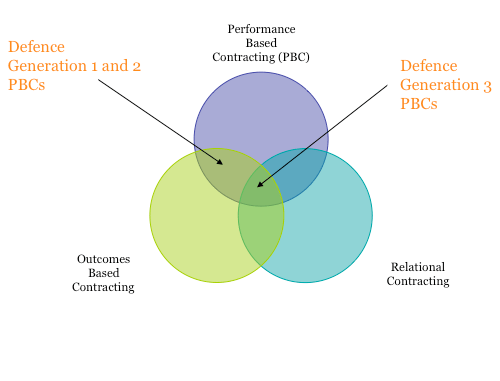
PBC Generations

The question is, as we continue to evolve PBCs, what will a generation 4 PBC look like?  Send me your thoughts.

Posted in Behaviours, Definition, Uncategorized | Tagged , , , , , , , , | 1 Comment

Understanding Behavioural Economics

In a previous post I had suggested those interested in Behavioural Economics should have a look at a free online course via http://www.edx.org titled Behavioural Economics in Action from the University of Toronto.

While you can do this course at any time via an archived version, I just noted that this course is running again based on what appears an annual cycle commencing on 15th October 2015 for those that like more interaction and potentially a course certificate.

You can get access to the course via the following link Behavioural Economics in Action.

Posted in Behavioural Economics, Behaviours, Nudging, the Why | Tagged , , , , | Leave a comment

The Allure of a Single Measure

The allure of a single performance measure is mesmerising. Its small data collection cost and its ability to focus management attention make this search an ongoing goal for many organisations. Unfortunately, while great in theory, this approach does not reflect the complexities of many of our workplaces.

A recent article in HBR by Graham Kenny highlighted that many organisations seek to use a single performance measure as the sole measure of organisational success. Typically, these measures are quantitative, lag indicators; that is a numeric measure that represents past (historic) performance. However, as the article and personal experience has shown this single-minded approach can lead to a range of unintended consequences.

For example, the use of single performance measure misses the need to look forward (lead indicators) and the need to “measure” softer aspects (subjective performance measures) as part of a balanced approach to performance management. Without it, we may drive personal and organisational behaviours based on historical performance that can only be numerically quantified. From the perspective of long-term arrangements such as Performance Based Contracts (PBCs), the guarantee of on-going performance relies on future conditions being the same as the past.

In an earlier post (When is a KPI not a KPI?) I suggested using a Performance Measure Hierarchy as a method for including all performance aspects; specifically, quantitative and qualitative, but lag (past) and lead (future). Moreover, that these tiers of performance measures:

  • represent a range of Key Result Areas (KRAs) which define contract (or organisational) success; and
  • linked to a range of rewards and sanctions.

For the specific management of Complex Materiel[1] I also recommend you look at another earlier blog on “Measuring and Incentivising Sustainment in the Age of Asset Management”.

So while we should all continue to search for new, and of course refine existing, performance measures we should resist the allure of the single measure lest it be a fool’s errand.

[1]             Complex Materiel is defined as those assets that support military operations through flying (e.g. aircraft and helicopters), sailing (e.g. ships, boats and submarines), driving (e.g. wheeled and tracked vehicles) and transmitting (e.g. satellite ground stations).

Posted in Performance Measure, the How | 3 Comments

PBC Penalty Shoot-Out!

In recent months I have been involved in a number of Performance Based Contracting (PBC) discussions between buyers and sellers. One consistent point of heated discussion is around the application of a reduction in seller payment as part of the Performance Management Framework (PMF) that, as those familiar with this blog, is 1 of the 5 key characteristics of a PBC. Specifically:

  1. Range of monetary and non-monetary consequences, either rewards or sanctions for the contractor, based on performance

So why am I bringing this up since it is a core part of a PBC?  The main reason is around language; specifically with the use of “penalty” to represent this reduction in seller payment.

Firstly, in Australia, where I am from, a penalty under Australian Law refers to a fine imposed when a person or organisation breaches a statute law (e.g. driving without a licence). Given a contract is not a statute a “penalty” cannot be applied to a seller in the circumstances of a failure to deliver contractual obligations.

Secondly, and my opinion more important, is the emotional use of “penalty” by many sellers. While some of you will disagree with this perspective, I ask whether applying monetary / non-monetary consequences to a seller based on their performance is a penalty? Similarly, am I applying a penalty to my local take-away restaurant when I won’t pay for all 3 dishes I ordered when they have only given me 2 of the 3 dishes? I am penalising them?

The reason we are very careful about using “penalty” is that, as one of my colleagues Matt McDonald puts it, the use of “penalty” is a cultural cancer. By using “penalty” it creates the impression that the sanctions (remedies) imposed in the PBC for a seller’s failure to perform is somehow unjust and unfair. Clearly, this is at odds with the intent of a PBC; that is sellers are accountable for their performance. However, whether these organisations use it intentionally as part of a negotiation strategy, or whether simply because it is a handy word, I will leave you to decide.

So I ask my fellow PBC practitioners, regardless of whether buyer or seller, to carefully consider whether the sanctions (remedies) being applied is truly a “penalty”. Or whether it is a performance abatement (or reduction in the performance fee) due to the seller’s failure to deliver.

I will let you be the umpire.

Posted in Basis of Payment, Consequence Analysis, Definition, the How | Tagged , , , , , , , | Leave a comment

Carrot and Stick (Part 1)

I am currently reading Richard Thaler’s new book, “Misbehaving – The making of Behavioural Economics” which has again brought up an interesting and long running debate on the application of positive incentives (gains or “carrots”) or negative incentives (losses or “sticks”) in Performance Based Contracts (PBCs). While this debate appears divided along the lines of buyer and seller, it also appears divided along regions (e.g. Australia vs. North America).

As with any debate there are 2 points of view. In this case the points of view are centred on how to motivate contractor performance as follows:

  • Approach 1 – ensures contractor performance by placing a proportion of contract price at risk for performance and applies remedies (negative incentives / loss / stick) if the required performance is not delivered.
  • Approach 2 – ensures contractor performance by having the contractor earn an amount of contract price (positive incentive / gain / carrot) based on performance against increasing levels of required performance.

Now I am guessing a few of you are thinking why the debate? That there is very little difference between the 2 approaches given the first approach takes money away for a failure to deliver while the second approach simply awards money for an ability to deliver. Mathematically the approaches are the same, including the contractor’s likelihood of delivering a certain level of performance. So why the ongoing debate?

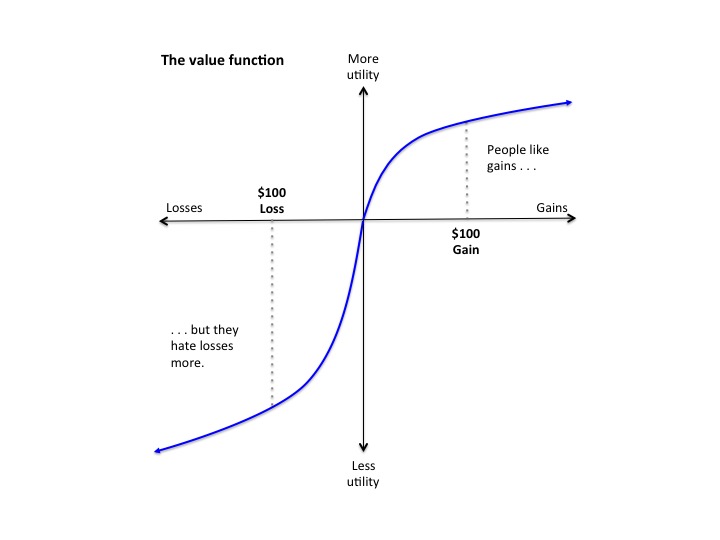
Well, this is where behavioural economics comes in and hence the reference to Thaler’s book. Specifically, there is a particular behavior called loss aversion which describes how humans are keen to eliminate loss altogether since losses hurt twice as much as gain makes you feel good. Figure 1 illustrates this effect.


The value function from Thaler.

Figure 1 – The value function from Thaler (see Figure 3, pg 31, “Misbehaving – The Making of Behavioural Economics“)

Accordingly, while mathematically and probabilistically the same, Approach 1 causes twice as much hurt as Approach 2 makes you feel good. But of course, feelings shouldn’t matter in a contract between 2 companies should they? Hopefully, you now see why the debate!

But more in this in Part 2.

Posted in Behavioural Economics, Behaviours, the Why | Tagged , , , , , , , , , | 1 Comment

Benefits of a Performance Based Contract

A common Performance Based Contract (PBC) question is what benefits do they offer over more conventional / traditional contracts?

While there is a lot of discussion on this topic, most is based on anecdotal evidence.  The lack of evidence is due to PBC success usually linked to both contractor performance and payment, two commercially sensitive topics, thereby making case studies that include evidence difficult to find.  However, there are a couple.

One such body of evidence is the United States Department of Defence (US DoD) Proof Point Project.  This project was established to analyse and provide evidence of the effectiveness and affordability of US DoD PBL strategies noting the similarity between US Performance Based Logistics (PBL) arrangements and PBCs.  This project found:

  1. properly structured and executed PBLs reduce Services’ cost per unit-of-performance while simultaneously driving up absolute levels of system, sub-system and component readiness (think availability); and
  2. average annual savings for programs with generally sound adherence to PBL tenets is 5-20% over the life of the PBL arrangement compared to transactional support.

However, the report also found that to deliver these benefits the PBLs must be skillfully constructed, managed, and renegotiated/ re-competed.

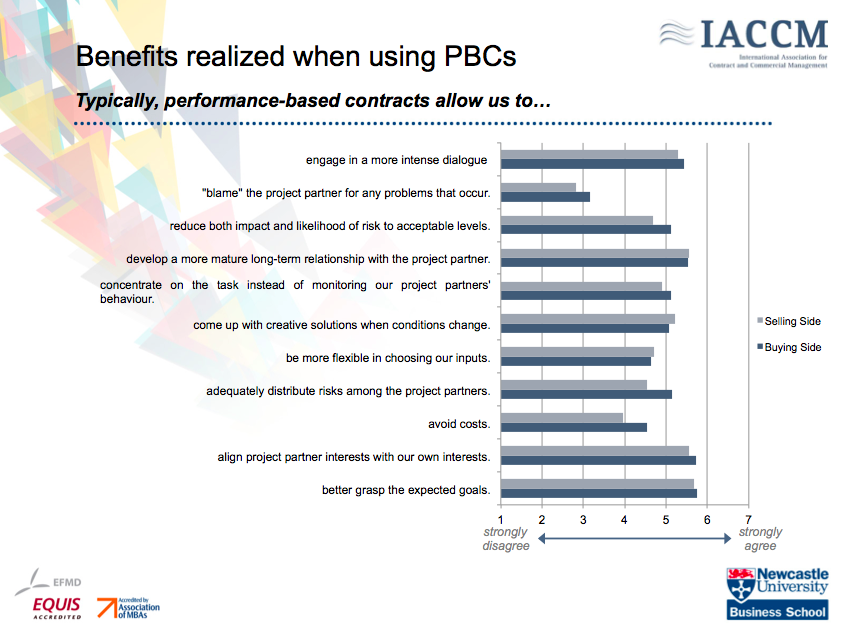
More recently, the International Association for Contract & Commercial Management (IACCM) conducted a study into performance or outcome based contracts .  Their report highlighted that while their use remains relatively immature across industry as a whole, their use in many cases was favourable.  Of note, the report highlighted that PBCs resulted in:

  1. better relationship between the buyer and seller, including being able to have the difficult conversations; and
  2. better performance through alignment of clear goals / expectations.

Details of the benefits realised when using a PBC is shown below in one of the slides presented by Tim Cummins (CEO of IACCM) at the recent DMO PBC Conference in Canberra, Australia.

Benefits of a PBC

Benefits of a PBC

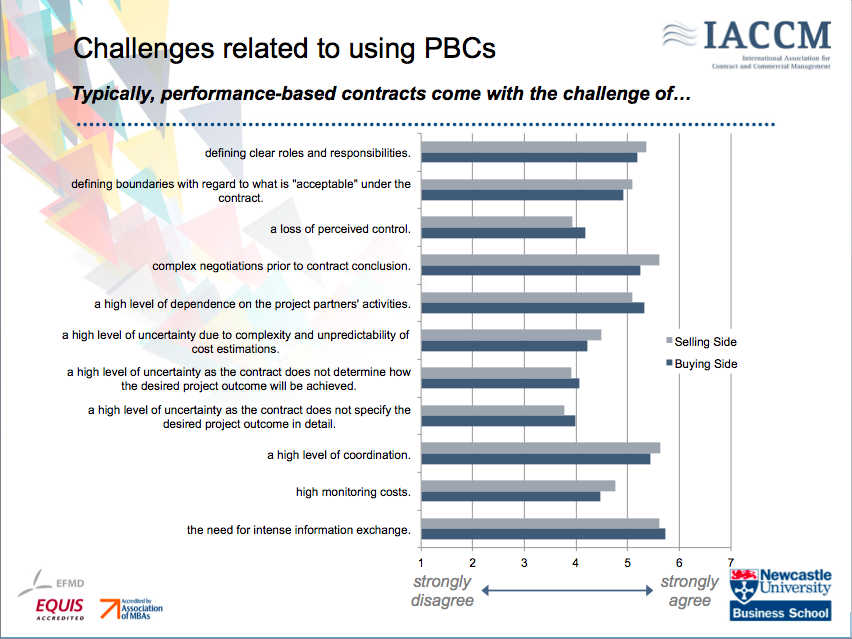
The IACCM report also highlighted a number of challenges.  Similar to the US Proof Point Project the IACCM report found a high level of complexity in establishing (e.g. including defining roles, responsibilities and desired performance outcomes) and negotiating PBCs.  Additionally, it found that PBCs also required a high level of coordination and information exchange.  Details of the challenges related to using a PBC is provided below is another slide presented by Tim Cummins at the recent DMO PBC Conference.

Challenges of a PBC

Challenges of a PBC

So the lesson learned from these and other reports is that while PBCs do deliver benefits (i.e. better performance through alignment of clear goals / expectations, reduction in cost and better relationship between the buyer and seller), to realise these benefits the PBCs must be skillfully constructed, managed, and renegotiated/ re-competed.   Something to discuss in a future post.

Posted in Benefits, the Why | Tagged , | Leave a comment

Thank You!

I just wanted to quickly post a big thank you to all the attendees and especially to the presenters at the Australia Defence Materiel Organisation Performance Based Contracting (DMO PBC) Conference which was held in Canberra, Australia on 26 – 27 May 2015.  Without your participation I don’t think it would have been as successful as it was.  So thank you.

For those that were unable to attend, the presentations from Day 1 will be available shortly.  I will provide a link once we have hosted them.

Finally, I also wanted publicly thank my team for all the hard work that they did before, during and after the conference, and especially Mike Desmond who was the lead in making this happen.  Thanks guys!

Again, thanks to everyone for participating and if you have any suggestions next years conference please let me know as we are already planning ahead!

Posted in Admin, PBC Conference | Tagged , | Leave a comment

Australian DMO Performance Based Contracting (PBC) Conference

I am pleased to announce the Australian Defence Materiel Organisation (DMO) Performance Based Contracting (PBC) Conference being held in Canberra, Australia over the period of Tuesday 26th to Wednesday 27th May 2015.

The reason for the conference is that as we approach the tenth anniversary of the first edition of the Aerospace Systems Division PBC Handbook in September 2005, it is an ideal time to pause and reflect on where we have come from, where we are and where we may be going in the future.

The aim of the forum is to bring together users, practitioners, policy makers and academics from both Defence and industry to discuss the future evolution of PBC in the next decade via case studies as well as international and academic perspectives.  During the conference, participants will hear from:

  • The DMO executive on their assessment of the current and future state of PBC
  • Project Offices and System Program Offices on their lessons learnt
  • Defence industry on their take on the application of PBC
  • Our international partners on their journey and their vision for the future
  • Academia on what is happening to PBC in the wider context
  • The DMO PBC Centre of Excellence (CoE) on their roles in making this vision a reality.

The conference is being hosted and facilitated by the DMOs PBC CoE and attendance at the conference is free. However, places are strictly limited so bookings will need to be made early noting that where necessary, the DMO PBC CoE may need to prioritise nominations.  You can get further information on the conference at DMO PBC Conference 2015 – Invitation and Brochure.

Kind Regards


Dr Andrew “Jacko” Jacopino
Executive Director, DMO PBC CoE

Posted in PBC Conference | Tagged , , , | Leave a comment

History of Behavioural Economics

For those you have read my thoughts on the use of Behavioural Economics as a method of optimising our approach to Performance Based Contracting (PBC) (see earlier posts on Is Your Contract Fun? and Designing Successful PBCs) I wanted to mention an article (From “Economic Man” to Behavioral Economics) from the Harvard Business Review (HBR) which provides a brief history on the rise of Behavioural Economics as a part of the wider field of Decision Making.  It also includes links to other interesting articles on this and similar topics of how we as humans make decisions.

I recommend you read this, and some of the other linked articles, and consider whether the Performance Management Framework in your PBC takes into account these factors as I believe that highly successful PBCs should skilfully use a contract’s Choice Architecture to nudge contractor behaviour by defining the consequences of their actions or omissions in the delivery of the required outcomes.

Posted in Behavioural Economics, Nudging | Tagged , , , , , , , | Leave a comment